


From 1 July 2026, Queensland’s Reportable Conduct Scheme is officially in effect, creating new legal obligations for organisations that work with children.
Established under the Child Safe Organisations Act 2024 and overseen by the Queensland Family and Child Commission (QFCC), the scheme introduces mandatory reporting and investigation requirements for allegations of child-related misconduct involving workers.
For employers, this means child safety concerns can no longer be managed solely through internal HR processes. Organisations must have clear reporting systems, investigation procedures, and compliance frameworks in place to meet their legal responsibilities.
Failure to comply may expose organisations and their leaders to significant penalties, regulatory action, and reputational damage.
Who Must Comply with Queensland’s Reportable Conduct Scheme?
The Reportable Conduct Scheme applies to organisations classified as reporting entities under the Child Safe Organisations Act 2024.
These organisations have responsibilities for children or provide services where children may be at increased risk.
Reporting entities may include:
- Early childhood education and care providers
- Child protection and youth support services
- Disability service providers supporting children
- Religious organisations, including youth groups and chaplaincy programs
- State schools, TAFEs, and universities
- Government departments and local government entities
If your organisation operates in a child-related sector, it is important to determine whether you are covered by the scheme and understand your obligations.
What Is Considered Reportable Conduct?
The Reportable Conduct Scheme applies to specific categories of behaviour involving children.
A reportable allegation may include:
| Type of Conduct | Examples |
| Sexual offences and sexual misconduct | Sexual offences or inappropriate sexual behaviour involving or in the presence of a child |
| Physical violence | Physical violence committed against or in the presence of a child |
| Ill-treatment and neglect | Serious mistreatment, neglect, or failure to provide appropriate care |
| Emotional or psychological harm | Behaviour that causes significant emotional or psychological distress to a child |
Importantly, employers do not need to prove that misconduct occurred before reporting.
A reportable allegation exists where information gives a person reasonable grounds to believe that a worker may have engaged in reportable conduct.
The focus is not on certainty. It is on taking appropriate action when there is a reasonable concern.
Key Employer Obligations Under the Reportable Conduct Scheme
The scheme places responsibility on the head of the organisation, such as a CEO, Principal, Director-General, or equivalent leader.
Employers must meet three key obligations.
- Establish Effective Reporting and Response Systems
Policies and procedures should align with the requirements of the Child Safe Organisations Act 2024.
- Notify the QFCC About Reportable Allegations
When a reportable allegation or conviction involving a worker is identified, the organisation must notify the QFCC within the required timeframe.
- Conduct a Proper Investigation
Employers must ensure allegations are investigated appropriately and fairly. A poorly handled investigation may create additional legal risks for the organisation.
Investigation Requirements Under Queensland’s Reportable Conduct Scheme
Investigating reportable conduct requires a structured approach.
- Step 1: Assess Immediate Child Safety Risks – The goal is to protect children while ensuring the process remains fair.
- Step 2: Notify Relevant Authorities – Where required, employers must notify the QFCC within the required timeframe.
- Step 3: Gather Evidence and Conduct Interviews – Investigators should understand trauma-informed practices, particularly when children or vulnerable individuals are involved.
- Step 4: Provide Procedural Fairness – Workers who are the subject of an allegation must be given a fair opportunity to respond.
- Step 5: Submit Findings to the QFCC – At the conclusion of the investigation, the organisation must determine whether reportable conduct occurred based on the balance of probabilities.
Does the Scheme Apply Outside the Workplace?
A key feature of Queensland’s Reportable Conduct Scheme is that it can extend beyond workplace behaviour.
- Off-Duty Conduct
- Conduct outside working hours may still be relevant if it affects a worker’s suitability to work with children or creates a risk for the organisation.
- Examples may include inappropriate online behaviour or private conduct involving children.
- Historical Allegations
- Historical allegations of child abuse may still require action if they are reported after 1 July 2026 and involve a current or relevant worker.
- Former Employees
- An employee resigning after an allegation is made does not automatically remove the organisation’s responsibilities.
- Depending on the circumstances, the organisation may still need to investigate and report findings to the QFCC.
Penalties for Failing to Comply
Ignoring obligations under the Reportable Conduct Scheme can result in serious consequences.
- Financial Penalties
- Failure to meet reporting requirements, including failing to notify the QFCC or provide required investigation reports, may result in penalties of up to 100 penalty units.
- Regulatory Oversight
- The QFCC has powers to monitor compliance and oversee investigations.
- Impact on Blue Card Assessments
- Where an investigation identifies concerns about a worker’s suitability to work with children, information may be shared with Blue Card Services for further assessment.
Ensure Your Organisation Is Ready for Queensland’s Reportable Conduct Scheme
The introduction of Queensland’s Reportable Conduct Scheme represents a significant change in how organisations must manage child safety concerns, workplace investigations, and employee misconduct allegations.
Employers should not wait until an allegation arises before reviewing their policies and procedures. Having the right systems, trained leaders, and compliant investigation processes in place can help protect children, support employees, and reduce legal risks.
NB Employment Law can assist organisations with reviewing workplace policies, strengthening compliance frameworks, and managing complex workplace investigations involving employee conduct and legal obligations.
If your organisation needs guidance navigating Queensland’s Reportable Conduct Scheme, speak with NB Employment Law for practical legal advice tailored to your workplace.
Join our upcoming webinar – 22 July 2026 (12:00 – 1:00 PM AEST)
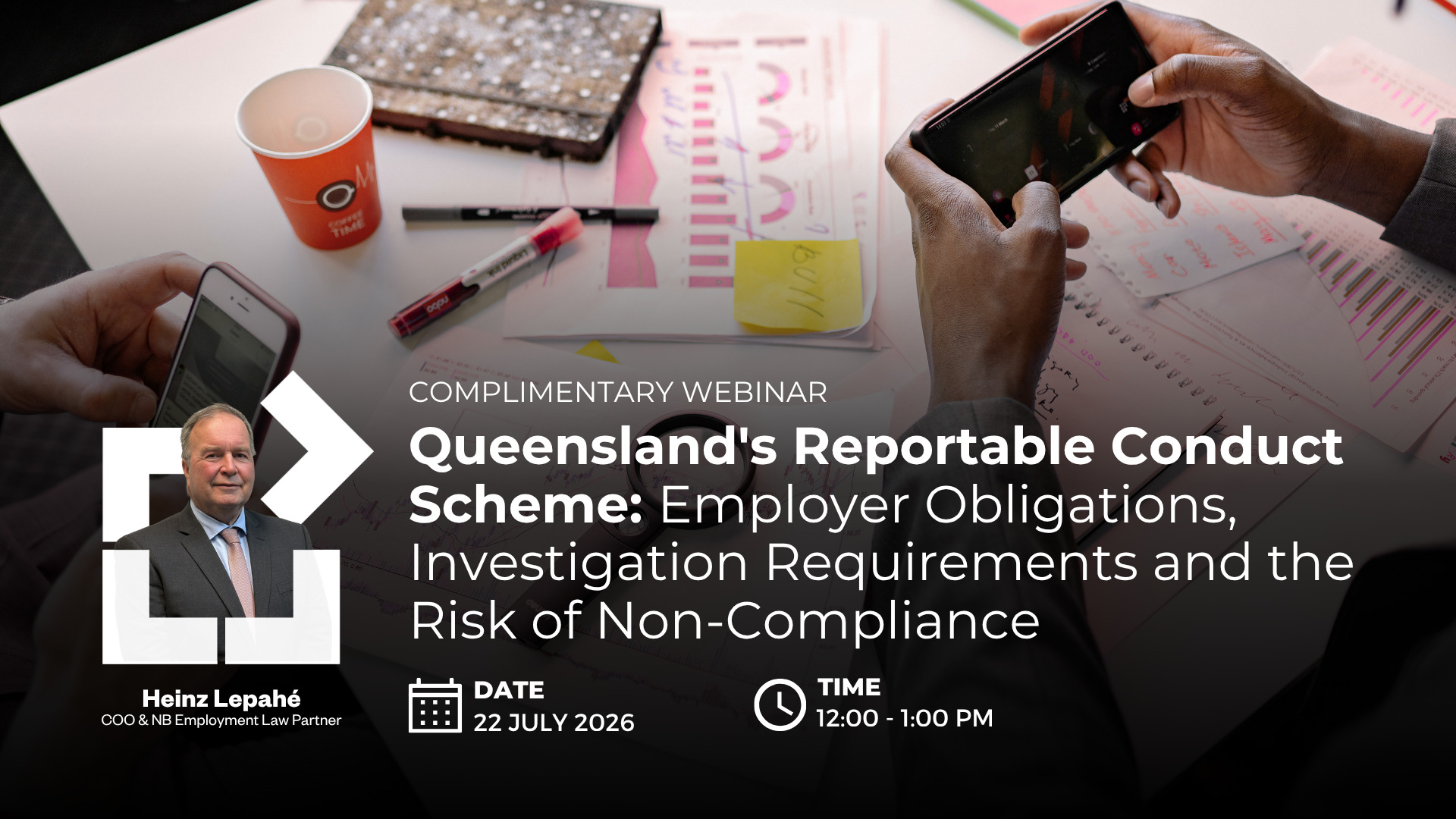
Queensland’s Reportable Conduct Scheme is now law. Is your organisation ready?
As of 1 July 2026, Queensland’s Reportable Conduct Scheme under the Child Safe Organisations Act 2024 is in force—and the obligations for reporting entities are already active.
Join our FREE webinar on 22 July 2026 | 12:00–1:00 PM and gain a clear, practical understanding of what compliance now requires.
We will cover:
✔️ What the Reportable Conduct Scheme requires of your organisation
✔️ CEO and leadership accountability under the new framework
✔️ The six categories of reportable conduct (and common missteps)
✔️ Off-duty conduct and historical allegations—when obligations are triggered
✔️ Notification requirements and the consequences of non-compliance
✔️ What systems and policies your organisation must have in place now
With penalties of up to $17,000 for failing to notify the QFCC and powers for regulatory intervention, the risks of getting this wrong are significant.
Designed for HR leaders, compliance teams, executives and safeguarding professionals, this session will provide the clarity needed to act confidently under the new regime.
Register now for this essential compliance briefing – Click Here